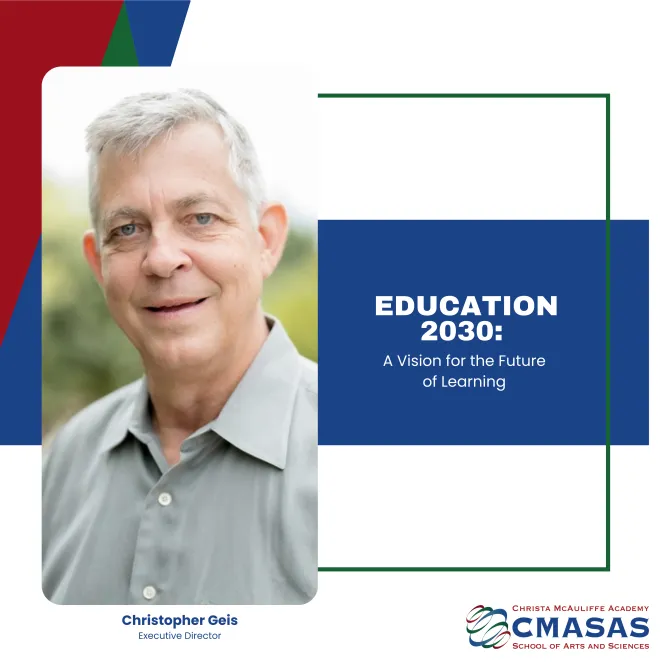
EDUCATION 2030: A VISION FOR THE FUTURE OF LEARNING
Every graduation season gives us an opportunity to reflect not only on what our students have accomplished, but also on where education is headed.
As we look toward 2030 and beyond, one thing is becoming increasingly clear: the world our students are entering will be dramatically different from the one many of us experienced growing up.
Artificial intelligence is transforming how information is accessed. Careers are evolving faster than ever before. Students entering elementary school today may ultimately work in professions that do not yet exist. The challenge facing educators is no longer simply teaching students what to know. It is helping them learn how to learn, how to adapt, and how to thrive in a constantly changing world.
Research from organizations such as the World Economic Forum, OECD, and leading universities consistently points to a common conclusion: future success will depend less on the memorization of facts and more on skills such as critical thinking, creativity, communication, collaboration, adaptability, resilience, and self-direction.
At CMASAS, these findings affirm what we have believed for many years.
Education should not be built around a one-size-fits-all model. Every student brings unique strengths, interests, goals, learning styles, and life experiences. The most effective learning environments recognize those differences and help students develop the confidence and skills to direct their own educational journey.
We call this Personalication.
Personalication is more than personalization. It is the belief that education should help students discover who they are, how they learn best, and how they can contribute to the world around them. It is about developing the whole person—not just academic performance, but character, resilience, curiosity, purpose, and a lifelong love of learning.
The future of education is not about replacing teachers with technology. In fact, research suggests the opposite. As technology becomes more powerful, human relationships become even more important.
- Students need mentors who know them.
- They need coaches who challenge them.
- They need educators who help them connect learning to purpose.
Technology can deliver information. Meaningful relationships help students transform information into wisdom.
By 2030, we believe successful schools will focus less on standardization and more on student agency. Students will increasingly take ownership of setting goals, managing projects, solving real-world problems, and reflecting on their growth. Learning will become more flexible, more individualized, and more connected to authentic experiences beyond traditional classrooms.
Rather than asking, "Did every student learn the same thing at the same time?" we should be asking, "Did every student grow? Did they discover their strengths? Did they develop the skills and confidence to navigate an uncertain future?"
Those are the questions that matter.
Another significant trend shaping Education 2030 is the growing recognition that families should have greater access to educational options, regardless of their income or geographic location.
For much of modern educational history, school choice was often limited to families with the financial means to relocate or pay private school tuition. Today, that landscape is changing.
Programs such as Arizona's Education Savings Accounts (ESA), Texas' Education Freedom Act, and similar initiatives across the country are creating opportunities for families to select learning environments that best meet their children's unique needs. These programs reflect a growing understanding that educational funding should support students, not systems.
At CMASAS, we view this as an important step toward educational equity. True equity is not achieved when every student receives the same educational experience. Equity is achieved when every student has access to the educational experience that allows them to succeed.
The future of education will not be defined by a single model. It will be defined by a diverse ecosystem of learning opportunities—including traditional schools, charter schools, private schools, online schools, microschools, hybrid programs, community partnerships, apprenticeships, and educational environments built around the principles of Personalication.
This democratization of educational choice may ultimately become one of the most important educational advancements of the next decade. When Personalication is available only to those with financial means, its impact is limited. When Personalication becomes accessible to all families, regardless of income, it becomes a force for educational transformation.
When Personalication is reserved for a privileged few, innovation benefits only a small percentage of students. When Personalication becomes available to every family, regardless of income, it has the power to transform education itself.
Many of the trends now being discussed as the future of education—student agency, personalized pathways, competency-based progression, flexible pacing, mentorship, mastery learning, and lifelong learning—have been foundational elements of the CMASAS model for years.
In many ways, Education 2030 is not introducing a new vision or educational learning model. It is validating a vision and learning model that educators, families, and students at CMASAS have been helping to build for decades.
The purpose of education has never been simply to prepare students for college or careers. Its deeper purpose is to prepare them for life.
The graduates of 2030 will need technical knowledge, certainly. But they will also need empathy, integrity, resilience, adaptability, and the ability to continue learning throughout their lives.
These are not future skills. They are human skills.
And they have always mattered.
As we continue to evolve and innovate, our mission remains unchanged: to help every student discover their unique path, reach their potential, and make a meaningful contribution to the world.
The future of education is not about creating better systems.
It is about helping students become better versions of themselves.
That is the future we are building together.