What Is an Accredited School and Why Is It Important?
Authored on
Revision Date:
Christa McAuliffe Academy School of Arts and Sciences (CMASAS) is accredited by the Accrediting Commission for Schools, Western Association of Schools and Colleges (ACS WASC). You may ask, what is an accredited school and why is this so important?:
An accredited school is a school that an independent accrediting agency has reviewed and found to meet established standards for teaching, curriculum, leadership, and student support. Accreditation is not a one-time stamp. Schools are reviewed on a regular cycle and must keep meeting those standards to stay accredited.
For families comparing schools, especially online schools, accreditation is one of the first things to check. It affects whether credits transfer, how colleges view a diploma, and how much confidence you can have in the education your child is getting. Accreditation carries that same weight, whether you are an online or brick-and-mortar school.
How School Accreditation Works: For K-12 schools, accreditation is voluntary. A school chooses to go through it. The process usually includes:
● A self-study. The school takes a hard look at its own programs, results, and goals.
● A visit from reviewers. A team of educators from the accrediting agency examines the school and talks with staff, students, and families.
● A decision and a plan. The agency grants accreditation for a set term and identifies areas for the school to improve.
● Ongoing review. The school reports progress and is re-reviewed before its term ends.
In the United States, several regional agencies accredit K-12 schools, including the Accrediting Commission for Schools, Western Association of Schools and Colleges (ACS WASC), Cognia, the Middle States Association, and the New England Association of Schools and Colleges (NEASC).
Why Is Being an Accredited School Important: Being an accredited school is important for several reasons:
1. Quality assurance: Accreditation ensures that a school meets established quality standards for education. Schools that are accredited have undergone a rigorous evaluation process to ensure that they meet specific academic and administrative standards, including faculty qualifications, curriculum, and student services.
2. Transfer credits: Accredited schools are more likely to have credits that transfer to other accredited schools. This means that students who transfer to another school or continue their education after graduation are more likely to have their credits recognized and accepted by other institutions.
3. Employer recognition: Employers often prefer to hire graduates from accredited schools because they know that these students have received a high-quality education. Accreditation indicates that the school has met established standards for education, and this can provide an added level of assurance to potential employers.
4. Financial aid: Accreditation is often a requirement for students to be eligible for federal financial aid programs. This means that students who attend an accredited school may have access to more financial aid options, making higher education more accessible and affordable. College admissions: Colleges and universities want to know that a diploma and transcript reflect real, verified coursework. An accredited high school diploma gives admissions offices that confidence, which keeps more doors open when it is time to apply.
5. Accountability over time: Because accredited schools are reviewed again on a regular cycle, they have to keep improving to keep their status. That ongoing check is something a one-time approval cannot offer.
In summary, accreditation is important because it ensures that schools meet established quality standards for education, allows for easier transfer of credits, provides assurance to employers, and increases access to financial aid. gives colleges confidence in a student's diploma.
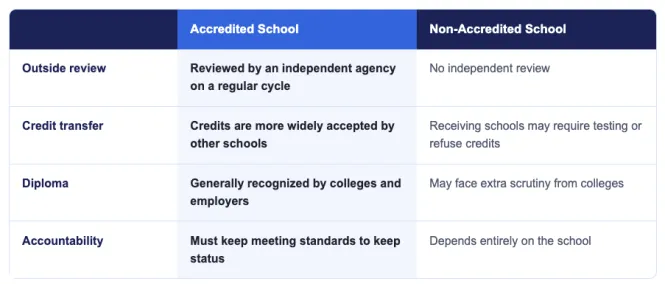
Accredited vs. Non-Accredited Schools: A non-accredited school is not automatically a bad school. Some excellent small schools never pursue accreditation. The difference is that no outside agency has verified the quality of the education, so families, colleges, and other schools have to take the school's word for it.
ADD TABLE HERE
How to Check If a School Is Accredited:
Checking takes a few minutes, and it is worth doing for any school you are considering:
1. Find the accreditor's name.The school should list it clearly on its website. If it only says "accredited" without naming the agency, ask.
2. Look the school up in the accreditor's directory. Most accrediting agencies publish a searchable list of the schools they accredit.
3. Confirm the agency is legitimate. Be wary of agencies you cannot find much about. Diploma mills sometimes cite accreditors they created themselves.
4. Check the status and term. Make sure the accreditation is current, not expired or on probation.
5. For athletes, check NCAA approval separately. Accreditation and NCAA course approval are different things. Student athletes should confirm the school's courses are approved by the NCAA Eligibility Center.
Looking for an Accredited Online School?
CMASAS combines WASC accreditation with fully self-paced, mastery-based courses and one-to-one coaching. CMASAS courses are also approved by the NCAA Eligibility Center (NCAA High School Code: 380581), so student athletes can stay on track for college sports.
Talk with our enrollment team about what an accredited online education could look like for your child.