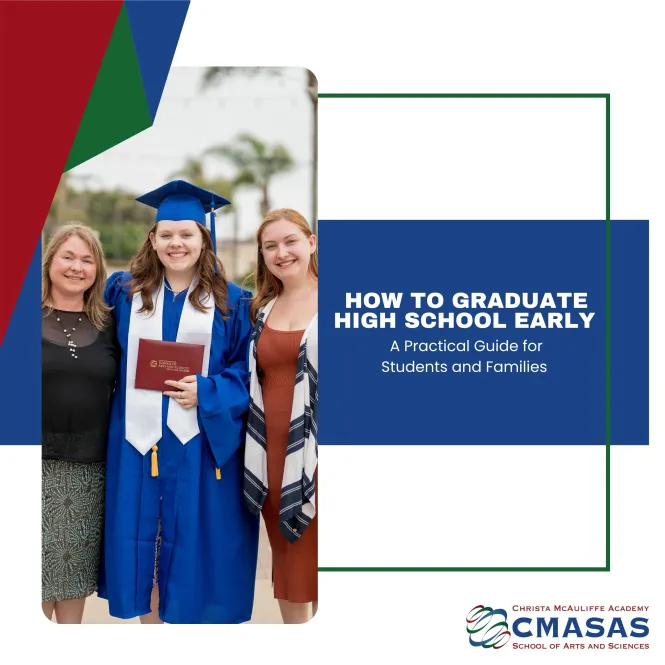
HOW TO GRADUATE HIGH SCHOOL EARLY: A PRACTICAL GUIDE FOR STUDENTS AND FAMILIES
Reviewed by: Kim Fowler, Director of Curriculum
Early graduation isn't about rushing through high school. It's about creating the right timeline for a student who is ready to move forward — whether that means starting college early, diving into career training, pursuing athletics or performing arts, traveling, or chasing another meaningful goal.
Can You Actually Graduate High School Early?
Yes — and here's why: high school completion is based on earning required credits, not on spending exactly four years in a classroom.
That said, early graduates don't skip anything. They complete the exact same diploma requirements as everyone else — just on a more personalized timeline.
In a traditional school, courses follow fixed semester schedules. Even a student who's ready to move faster often has to wait until the next term to start a new class. But in a self-paced, mastery-based school, students move forward the moment they demonstrate understanding, which makes acceleration far more natural and manageable.
A remarkable milestone: Twin students at CMASAS graduated at age 13 after successfully completing their diploma requirements.
Is Early Graduation Right for Your Student?
Early graduation may be a great fit for students who:
- Are academically ready to move more quickly
- Have a clear college, career, athletic, or personal goal
- Work independently or respond well to structured support
- Need more flexibility than a traditional schedule allows
- Want to begin college-level coursework sooner
But speed shouldn't be the only goal. The best graduation timeline isn't always the fastest one — it's the one that supports the student's goals, readiness, and well-being.
Six Steps to Graduating Early
1. Choose a Target Date
Decide whether the goal is to graduate one semester early, one year early, or on another accelerated timeline. Having a clear target shapes every decision that follows.
2. Review the Transcript
Take stock of where things stand:
- Credits already earned
- Courses currently in progress
- Graduation requirements still remaining
- Prerequisites that may affect course sequencing
3. Select the Right Diploma Path
CMASAS offers two diploma options:
- Standard Diploma — 20 credits - Designed to meet CMASAS and Oregon core graduation requirements. Students planning to attend college should work closely with their school counselor to make sure their coursework also satisfies college admission requirements.
- College Prep Diploma — 24 credits - Includes additional elective credits and is designed to help students meet the general admission expectations of many four-year colleges and universities.
4. Map the Remaining Courses
Build a written course plan that covers:
- Course sequence
- Expected completion dates
- Weekly pacing goals
- Summer or year-round coursework
- College or career planning deadlines
5. Coordinate What Comes Next
Early graduation is only half the equation — the next step matters too. Consider college applications, financial aid, NCAA eligibility, dual enrollment, career programs, athletic schedules, or other post-graduation plans well in advance.
6. Review Progress Regularly
An accelerated plan should include consistent checkpoints. If the pace becomes too demanding, the timeline can — and should — be adjusted.
How CMASAS Supports Early Graduation
CMASAS was built around a simple principle: students should move forward when they demonstrate mastery — not merely when the calendar says it's time.
Here's what that looks like in practice:
Self-Paced, Mastery-Based Courses: Students progress after demonstrating at least 80% mastery, so motivated students can move at a pace that matches their ability.
No Unnecessary Waiting: Once a student finishes a course, they can start the next one immediately — no waiting for a new semester to begin.
Year-Round Enrollment: Students can start anytime, rather than being locked into a traditional fall or spring start date.
A Personalized Education Plan: Every full-time student gets an individualized academic plan built around their courses, goals, and anticipated graduation date.
Weekly Personal Support: A dedicated Personalized Education Coach meets with each student regularly to help them stay organized, accountable, and encouraged.
College and Career Planning: Students get support coordinating their graduation plan with college admissions, dual enrollment, NCAA requirements, and future goals.
Important Transfer Requirement: Transfer students must complete at least 25% of their required graduation credits through CMASAS, with a minimum of five full-year credits. Students must also be enrolled full-time at the time of graduation and have been on a full-time enrollment plan for at least one semester immediately before graduating.
One important note: self-paced doesn't mean unsupported — or effortless. Early graduation still requires consistent effort, thoughtful planning, and regular communication.
Frequently Asked Questions
How early can a student graduate? It depends on completed credits, remaining requirements, prerequisites, and the student's pace. Some students finish a semester early, others a full year early, and some complete high school in about three years.
Can students graduate early through an online school? Yes. A self-paced online program often makes acceleration more practical, since students can begin their next course as soon as they finish the previous one — no waiting for a new semester.
Do early graduates complete fewer credits? No. Every student must satisfy the same diploma requirements, regardless of timeline.
Can a transfer student graduate early from CMASAS? Potentially. CMASAS first reviews the student's transcript to determine which credits transfer, what requirements remain, and whether the student can complete the required CMASAS credits within the desired timeline.
Does graduating early hurt college admission chances? Not necessarily. Colleges generally look at the rigor, completeness, and quality of a student's academic record. The key is making sure the accelerated plan still meets the specific admission requirements and deadlines of the colleges being considered.
Can students earn college credit while still in high school? Yes. Depending on eligibility and course availability, students may combine their high school plan with dual enrollment, AP, or college-level coursework.
What if the student changes their mind? No problem — the plan can be adjusted. A student may return to a more traditional pace, graduate only slightly early, or use the extra time for advanced courses and electives.