
AP vs. Honors vs. Dual Enrollment: Key Differences
AP, Honors, or Dual Enrollment: What's the Difference and Which Should You Take?
If you're choosing next year's schedule, you've probably hit the same question almost every college-bound student asks: what's actually the difference between AP, honors, and dual enrollment classes, and which one should you take?
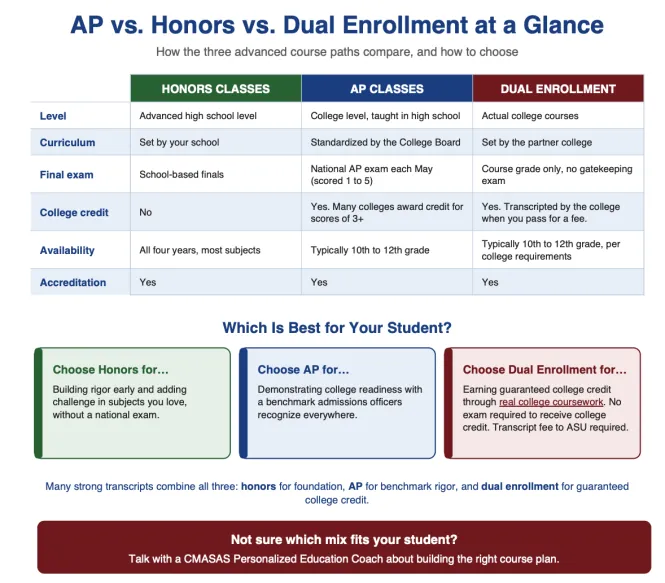
Here's the short answer: honors classes are more rigorous versions of standard high school courses. AP (Advanced Placement) classes are college-level courses that can earn college credit through a standardized exam. Dual enrollment classes are actual college courses that earn both high school and college credit at the same time, with no exam required. All three strengthen a transcript. The right mix depends on your student's goals, and many strong transcripts include all three.
What Are Honors Classes?
Honors courses cover the same subjects as standard classes such as English, biology, and U.S. history, but they expect more independent work. Because each school designs its own honors curriculum, there's no national exam at the end. Your grade comes from your performance in the course itself. Honors classes are often the first step in a rigorous course sequence. Many students take honors courses in 9th and 10th grade to build the foundation (and the transcript) for AP or dual enrollment courses in 11th and 12th grade.
What Are AP Classes?
AP courses are college-level classes taught in high school, with curriculum standardized by the College Board. Every AP course leads to a national exam in May, scored from 1 to 5. Score a 3 or higher, and many colleges and universities will award you college credit or advanced placement out of intro courses, before you've paid a dollar of tuition. The exam is both AP's strength and its catch. It's a benchmark admissions officers recognize at every high school in the country, but the college credit depends entirely on how you perform on one test in May, and on each college's score policy.
CMASAS offers a robust college prep offering with more than 14 AP courses online from AP Calculus and AP Biology to AP Art History and AP Computer Science Principles.
What Is Dual Enrollment?
Dual enrollment means taking an actual college course while you're still in high school, and earning high school credit and college credit for the same class. The curriculum comes from the partner college (for CMASAS that is Arizona State University), the grade goes on a real college transcript, and there's no national exam standing between you and the credit. Pass the course, earn the credit.
That's the key difference from AP: dual enrollment credit is earned by your work across the whole course, not by one exam in May. For students who perform better through steady coursework than high-stakes testing, that structure can be a meaningful advantage. One thing to know: because dual enrollment grades live on a permanent college transcript, they follow your student into college. That's a strong incentive to take these courses seriously, and a real head start when they do.
CMASAS students can choose from more than 60 dual enrollment courses through Arizona State University, earning transcripted ASU credit alongside their high school credit. Students can also take dual enrollment courses locally at a community college or university and transfer those credits back for high school credit. In some states this dual enrollment option is free or for a very reduced cost for high school students.
Is Dual Enrollment Better Than AP?
Neither is universally better. They solve different problems, and we often recommend a mix. Dual enrollment is the more reliable path to credit. Pass the course and the credit exists on a college transcript, full stop. AP credit depends on your May exam score and the receiving college's policy. A 3 might earn credit at one school and nothing at another. AP is the more universal admissions benchmark. Because every AP course follows the same College Board curriculum and exam, admissions officers can compare AP performance across every high school in the country. Dual enrollment rigor varies by partner college, so highly selective schools sometimes weigh AP more heavily in admissions, even though dual enrollment credit is often more usable once you're enrolled.
Transferability is the fine print for both. Before counting on either for credit, check the policies of the colleges on your student's list: AP score requirements on one side, transfer credit rules (which are typically friendliest with in-state and partner institutions) on the other.
Do Colleges Prefer AP, Honors, or Dual Enrollment?
Colleges want to see that you challenged yourself with the most rigorous courses available to you, and admissions officers genuinely check. Here's how that works behind the scenes: when our seniors apply to college, the school counselor completes a rating in the Common App comparing each applicant's course selection to other college-prep students. The answer choices range from "less than demanding" to "most demanding," and course rigor directly shapes that rating. Colleges see it alongside your transcript. AP and dual enrollment courses both strengthen that rating; honors courses build toward it.
So the honest answer: AP and dual enrollment generally carry more weight than honors because both represent college-level work. AP is a standardized national benchmark, and dual enrollment is proof a student already succeeded in a real college course. But an honors course a student excels in serves them better than an AP or college course they struggle through. Rigor only helps when it's paired with strong performance.
Is AP Harder Than Honors? Where Does Dual Enrollment Fit?
AP is usually harder than honors. AP courses move at a college pace, demand more reading and writing, and culminate in a cumulative national exam. Honors courses are challenging, but the difficulty is calibrated to advanced high school work, not college work. Dual enrollment sits alongside AP in rigor, because it is college work, but the pressure is distributed differently. Instead of everything riding on a May exam, your grade builds across the whole course. Some students find that structure less stressful. Others find the pace and independence of a true college course to be its own challenge. That said, difficulty varies by subject and by student. A student passionate about history may find AP U.S. History easier than Honors Chemistry. The right question isn't "which is harder?" It's "which challenge matches my strengths and goals?"
How Many Advanced Classes Should You Take?
There's no magic number. A sustainable guideline our instructional support team shares:
- Freshman/sophomore year:** Start with honors courses in your strongest subjects. Add a first AP or dual enrollment course in 10th grade if you're ready.
- Junior year: This is the transcript colleges scrutinize most. Two to four advanced courses, in whatever mix of AP, honors, and dual enrollment fits your student, is a strong load for most college-bound students.
- Senior year: Maintain rigor, because colleges see your senior schedule, but don't overload past what you can perform well in.
Balance matters more than volume. Colleges would rather see three advanced courses with As and Bs than six with Cs. A sustainable schedule protects both strong performance and your student's well-being, which matter more than any single course label.
Taking AP, Honors, and Dual Enrollment Classes Online
One advantage of a self-paced online school: you don't have to choose between rigor and balance. Because CMASAS courses are asynchronous and mastery-based, students can give an AP or college course the extra time it deserves without the scheduling collisions of a traditional school day. That structure works especially well for athletes, performers, and advanced learners managing demanding commitments.
For many students, the strongest transcript combines all three paths: honors courses for foundation, AP for benchmark rigor, and dual enrollment for guaranteed college credit. Every full-time student builds their course plan with a Personalized Education Coach (PEC), and our counseling team is available to help you decide which mix fits your college goals.
These advanced course options will challenge you in a particular field of interest/study, provide opportunity to receive college credit, prepare you for higher level learning at the college level, and offer you a sense of accomplishment.
Current CMASAS students may contact me, the school counselor, for more information on local (in person) dual enrollment options, our ASU dual enrollment program, or any questions regarding AP or Honors courses.
Ready to build a transcript that stands out? For prospective CMASAS students, explore our high school course catalog or connect with our admissions team to talk through your education options at CMASAS. We'd love to help you find the right mix.